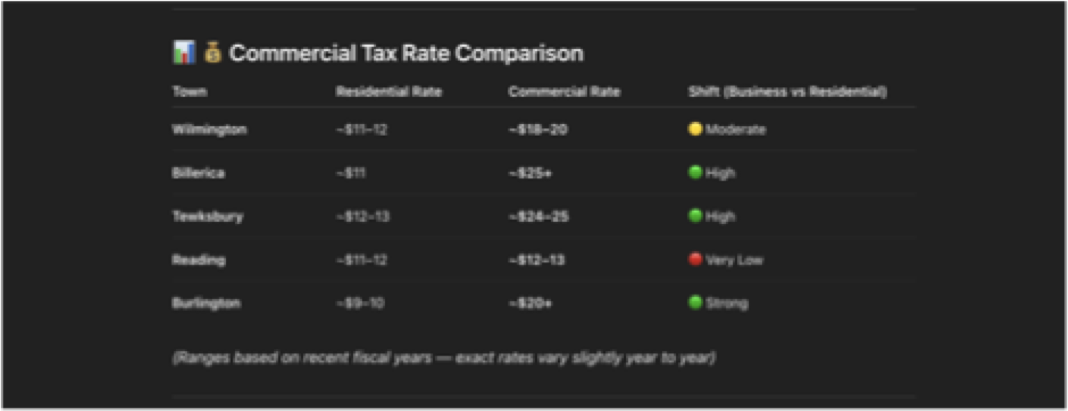
A concise reference on how Wilmington compares to nearby communities on commercial tax revenue, why it matters for homeowners, and how we can grow our business base so more spending stays in town.
Commercial tax revenue comparison
Approximate commercial revenue figures help illustrate how much of the tax burden businesses carry versus residents. Growing the commercial base can reduce the share borne by homeowners.
Town
Commercial revenue
Est. % of levy
Strength level
Burlington
$90M+
60–70%
🟢 Very strong
Billerica
$35M–$50M
35–45%
🟢 Strong
Wilmington
~$40M
30–40%
🟢 Strong (↑)
Tewksbury
$25M–$40M
25–35%
🟡 Moderate
Reading
$12M–$18M
15–25%
🔴 Residential-heavy
Figures are illustrative ranges for discussion; verify current numbers with town budgets and assessors as needed.
What this means (simple breakdown)
Burlington
Major commercial hub. Businesses carry a large share of the tax burden.
Billerica
Strong industrial and commercial base. Closer to a balanced tax structure between commercial and residential.
Wilmington
Roughly ~$40M in commercial revenue, with an estimated 30–40% of the levy from commercial—strong relative to our size (overperformer relative to size).
Wilmington lacks a stronger “destination” economy—restaurants, retail, and entertainment that pull spending in from elsewhere. A key issue: people often spend money outside Wilmington.
Tewksbury
Similar revenue range, but uses higher business tax rates in part to help make up the difference.
Reading
Mostly residential. A smaller commercial base means more of the burden falls on homeowners.
Critical insight
Wilmington does not have the lowest commercial share in this comparison—but it is still underperforming its potential. There is room to grow smartly.
The real gap
It is not only about headline tax revenue. Wilmington is missing pieces of a fuller local economy:
Restaurants and gathering spots
Retail
Entertainment
Business hubs and clusters
The result: money flows out of Wilmington for dining, shopping, and services residents use every week—instead of strengthening our own tax base and storefronts.
What else can Wilmington do to bring more businesses into town?
Over the past few years, Wilmington has already taken some important steps—like modernizing alcohol regulations and reviewing zoning barriers—and that is a great start. But now we need to focus on execution and results.
First, we need to make it easier to open and operate a business here. That means continuing to streamline permitting, reducing unnecessary barriers like excessive parking requirements or any other barriers.
Second, we should focus on creating destination areas—not just scattered businesses. Whether it is along Main Street or key corridors, we need clusters of restaurants, coffee shops, and small retail that create energy and keep people in town.
Third, we need to be proactive. We should not just wait for businesses to come to us—we should actively recruit the types of businesses our residents are already asking for, and market available spaces so we are filling vacancies quickly.
At the end of the day, this is about keeping Wilmington families—and their spending—right here in Wilmington. If we do that, we strengthen our local economy and reduce the burden on taxpayers.